
From formulation to aerosol performance: What should be measured when developing an inhaled therapy?

Successful inhaled therapy development depends on more than the medicine or the delivery device alone. The two must work together. A formulation that performs well with one device may behave differently with another. For this reason, the developmentneeds to assess the device–formulation combination as a system.
Appropriate testing helps establish:
- whether the formulation can be aerosolized,
- what kind of aerosol is produced,
- how much drug leaves the device,
- and whether performance remains consistent under relevant conditions.
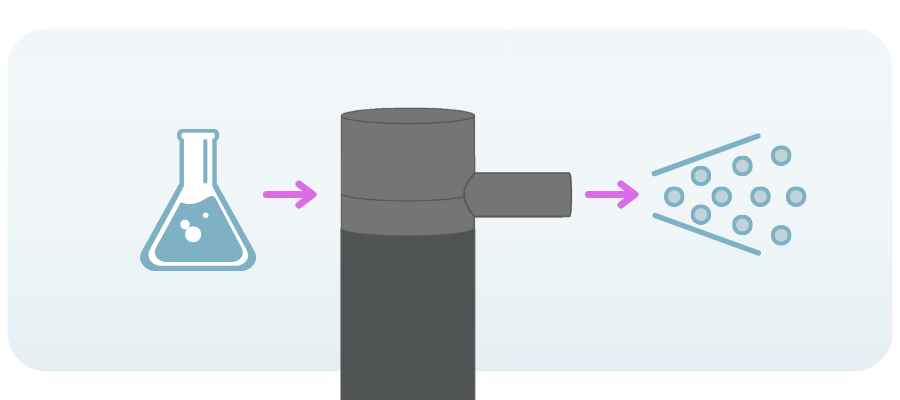
I. Can the formulation be nebulized effectively?
The first question is whether the device can generate an appropriate aerosol from the formulation in a reliable and practical way. The properties of the liquid can influence how a mesh nebulizer performs, so compatibility should be assessed using the intended formulation and device configuration.
Depending on the product, important factors to evaluate include:
- Formulation properties: Properties such as viscosity can affect how a liquid passes through the nebulizer’s mesh and forms aerosol droplets. A formulation that is too viscous for a particular device may reduce output or contribute to mesh blockage.
- Nebulization time: The time required to nebulize the intended dose. A shorter treatment time may be beneficial for patient usability, provided the aerosol and dose performance remain suitable.
- Output rate: The amount of drug emitted over a defined period.

II. What are the characteristics of the aerosol?
Aerosol size distribution strongly influences respiratory tract transport and deposition, but it is not the sole determinant. Results should always be interpreted considering the formulation, device, and test method.
Depending on the development strategy, relevant parameters may include:
- Droplet or particle diameter: A measure of the size of the aerosol droplets or particles. Size influences their transport and potential deposition in the respiratory tract; but it should not be interpreted as a guarantee of where the drug will deposit.
- Volume median diameter (VMD): The diameter that divides the measured aerosol volume into two equal halves: 50% is associated with smaller droplets and 50% with larger droplets. It is commonly reported by laser-diffraction methods.
- Mass median diameter (MMD): The diameter that divides the aerosol mass into two equal halves by weight.
- Geometric standard deviation (GSD): Describes the spread of the aerosol size distribution: a lower GSD indicates a narrower distribution and a higher GSD a broader one. Vibrating mesh nebulizers, for instance, often produce narrower distributions than DPIs, though values depend on the formulation, device, and test method.
- Aerodynamic particle size distribution (APSD): A description of the aerosol based on aerodynamic diameter, which reflects how particles behave in an airstream and therefore how they are likely to move through the airways.
Common methods include:
- Laser diffraction: Measures how an aerosol scatters laser light and uses the scattering pattern to estimate the droplet or particle size distribution in real time.
- Cascade impaction: Separates aerosol particles by aerodynamic size as they pass through a series of stages. The drug collected on each stage is then quantified, which allows APSD and related measures such as MMAD, GSD, and fine particle fraction to be determined.
- Microscopic mesh evaluation: Examines the mesh structure, including the size, shape, and uniformity of its apertures, which can influence droplet size and aerosol generation. More about this topic here.
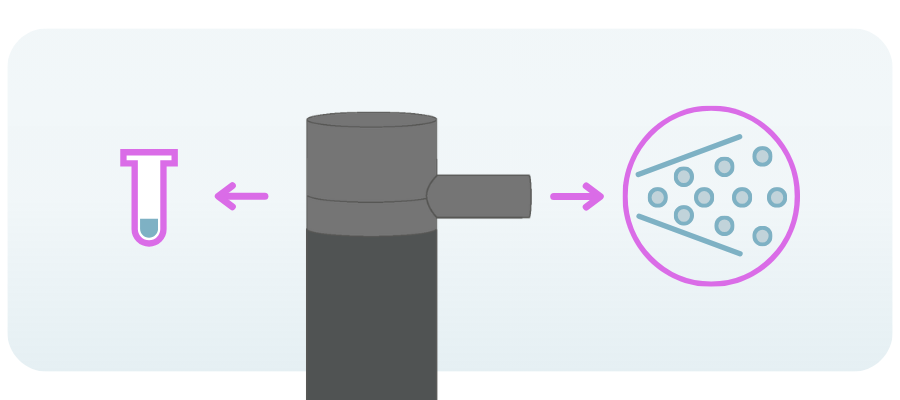
III. How much drug is emitted by the device?
The amount of formulation placed in a device is not necessarily the amount that leaves it as an aerosol available for inhalation. Measuring drug output helps to understand how much of the intended dose is emitted and how much remains in the delivery system.
Depending on the product and test method, relevant measures may include:
- Loaded dose: The amount of drug placed in the device before use.
- Emitted dose: The amount of drug that leaves the device under defined test conditions.
- Residual dose: The amount of drug remaining in the device after use. It helps explain the difference between the loaded and emitted dose. Some nebulizers retain a higher residual volume even under normal operating conditions, so a lower emitted dose does not necessarily indicate a performance problem. The residual volume depends on the device design and fill volume.
- Output rate: The amount of liquid or drug emitted per unit of time.
- Fine particle fraction (FPF): The proportion of the measured aerosol dose below a specified aerodynamic diameter, commonly 5 µm (respirable fraction). The result depends on the test method and on the denominator used, for example the emitted dose or the total recovered dose, so the basis should always be stated.

IV. Is performance consistent and reproducible?
A single measurement provides only a snapshot. Pharmaceutical development needs to establish how much performance varies between tests and whether the device–formulation combination performance remains stable under relevant conditions.
Performance may be assessed across:
- Multiple repetitions: Assess whether results are consistent across replicate tests.
- Different device configurations: Determine whether changes to relevant device components or settings affect performance.
- Different operating conditions: Evaluate the effect of conditions such as temperature and humidity where relevant to intended use.
- Different storage conditions: Assess whether storage affects the formulation or subsequent aerosol and dose performance.

V. Feasibility assessment: does the concept work?
Before committing to extensive development, a feasibility assessment can help determine whether a drug–devicecombination is technically viable and deserves further development.
An initial assessment may consider:
- Formulation–device compatibility: Can the selected device handle the formulation and generate a respirable aerosol?
- Aerosol generation: Are the aerosol characteristics, output rate, and nebulization time suitable for the intended product?
- Dose delivery: Is an appropriate amount of drug emitted, and is the particle-size distribution in the ideal range?
- Initial reproducibility: Can the combination produce comparable results across repeated tests?
If you are considering a new formulation for inhaled delivery, our team can support you with a tailored feasibility package to evaluate aerosol characteristics, drug output, and key performance parameters.
Contact our team via partnering@pulmotree.com to discuss your formulation and identify an appropriate feasibility assessment for your development needs.