Assessing The Impact Of Realistic Breathing Profiles
Authors: Carolina Dantas (Medical & Scientific Affairs) and Ulf Krueger (CEO), PULMOTREE Medical GmbH
in collaboration with William Ganley and Robert Bootle (Nanopharm, an Aptar Pharma Company), Hosein Sadafi and Ana Costa (Fluidda), and Janis Shute* (Ockham Biotech Ltd)
In memory of Professor Janis Shute
13. May 2026
Standard in-vitro testing of inhaled therapies relies on predefined breathing profiles that rarely reflect how patients actually breathe — creating a gap between in-vitro predictions and real-world outcomes.
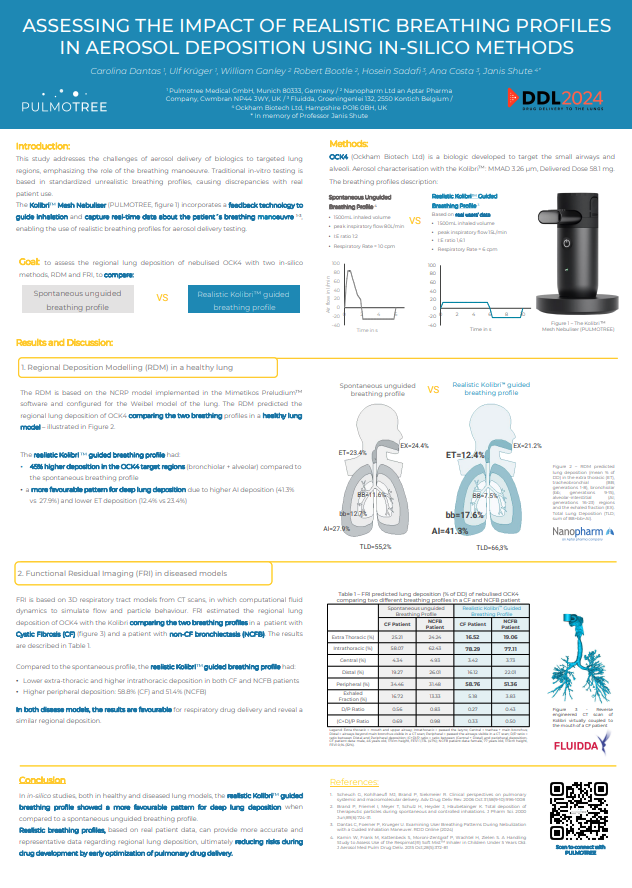
At the Drug Delivery to the Lungs (DDL) Conference 2024, Carolina Dantas (PULMOTREE) presented the poster “Assessing the Impact of Realistic Breathing Profiles in Aerosol Deposition Using In-Silico Methods“, investigating whether patient-derived breathing data can improve the accuracy of aerosol deposition predictions in drug development.
Using the Kolibri™ Mesh Nebulizer Platform, the study compared a realistic guided breathing profile — based on real user data — against a spontaneous unguided profile, applying two in-silico methods: Regional Deposition Modelling (RDM) in a healthy lung and Functional Respiratory Imaging (FRI) in Cystic Fibrosis and non-CF bronchiectasis models.
Across all models, the Kolibri™ guided profile consistently showed more favourable deep lung deposition, with 45% higher deposition in the target lung regions and significantly lower extra-thoracic losses.
The findings reinforce the value of incorporating realistic, patient-derived breathing profiles into in-silico workflows to support earlier and better-informed decisions in pulmonary drug development.